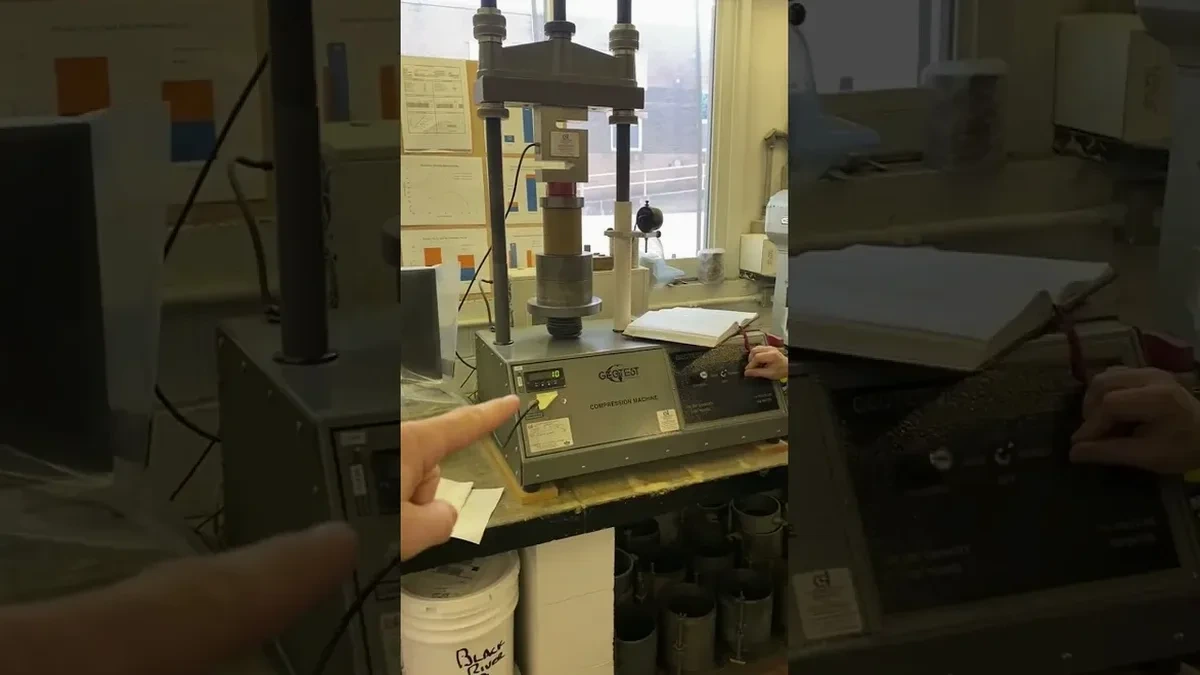
Birkenhead sits on a mix of glacial till and Mercia Mudstone, with the Mersey shoreline adding a layer of soft alluvial clay in many areas. The town’s population of around 90,000 has driven steady redevelopment of old docklands and Victorian terraces, where ground conditions vary significantly within a single street. That variability is exactly why we run unconfined compression tests on almost every cohesive sample from this side of the Mersey. The UCS value gives us a direct measure of undrained shear strength in saturated clays – a parameter needed for foundation design on the soft estuarine deposits near the waterfront. We typically supplement this with a study of soil mechanics to cross-check consistency across the site.
On glacial till from Birkenhead’s eastern ridge, UCS values typically range 90–130 kPa, matching the consistency of a stiff clay.
Process overview
One recent project involved a four-storey apartment block off Borough Road, where the client wanted to reuse an existing basement. The design team needed undrained shear strength values for the stiff glacial till below the fill layer. We cored five boreholes and ran unconfined compression tests on undisturbed samples. The results showed a consistent 90–130 kPa range, which allowed the structural engineer to proceed with a raft foundation without overdesign. For cohesive layers that appear heterogeneous, we often combine UCS data with a CPT sounding to capture continuous strength profiles. The procedure itself follows BS 1377-7: we trim a cylindrical specimen, load it axially at a controlled strain rate, and record the peak stress. No confining pressure is applied, which makes the test fast and cost-effective for routine projects.
Technical reference image — Birkenhead
Local context
Birkenhead expanded rapidly during the 19th century, with much of the housing stock built directly on glacial till or made ground from dock excavation. That legacy means many existing buildings have shallow strip footings founded on variable clay. When you drill a borehole next to a Victorian wall and retrieve a sample with visible fissures or root holes, the unconfined compression test gives you the intact strength – but it won’t capture the blocky jointing that can reduce in-situ strength. That’s why we always advise pairing UCS results with a stability analysis for excavations when working near old retaining walls or basement sides.
We receive 100 mm or 75 mm thin-walled tubes from your site, extrude and trim specimens in our UKAS-accredited lab, and report peak stress, failure strain, and stress-strain curve within 5 working days.
02
UCS on block samples from test pits
For shallow excavations in stiff clay or weathered mudstone, we cut block samples on site, seal them, and perform the test in our humidity-controlled lab to preserve natural moisture content. Ideal for retaining wall design and slope stability checks.
This service complements our laboratory testing work for a complete project analysis.
Relevant standards
BS 1377-7 — Standard Test Method for Unconfined Compressive Strength of Cohesive Soil, BS 1377-7:1990 — Methods of test for soils: shear strength tests (total stress), Eurocode 7 (EN 1997-2:2007) — Ground investigation and testing
Common questions
What is the difference between UCS and triaxial test?
UCS applies no confining pressure, so it measures the undrained strength of saturated cohesive soil under zero lateral stress. A triaxial test (CU or UU) applies cell pressure to simulate in-situ stress conditions. For soft Birkenhead clays near the Mersey, UCS usually gives a slightly lower strength than triaxial UU because the sample cannot mobilise any confinement.
How many UCS specimens do I need per borehole?
For a typical residential project in Birkenhead, we recommend 2–3 UCS tests per cohesive stratum, spread across different depths. For larger developments (e.g., blocks of flats near the town centre), 4–6 tests per layer give a reliable statistical spread, especially where the glacial till shows colour or fabric changes.
Can UCS be used for settlement calculations?
Not directly. UCS gives undrained shear strength, not stiffness. For settlement estimates you need oedometer modulus or Young’s modulus from triaxial with local strain measurement. However, UCS can offer a quick consistency check: if the unconfined strength is very low (<50 kPa), you can expect high settlement under load, so you should consider Improvement.
What sample quality is required for a valid UCS test?
The sample must be undisturbed, with minimal disturbance from extrusion. We check for visible cracks, root holes, or drying cracks before testing. In Birkenhead’s glacial till, block samples from test pits often give better quality than thin-walled tubes because the tubes can distort the sandier lenses. If the specimen crumbles during trimming, we report it and recommend a different test method.
How much does the unconfined compression test cost in Birkenhead?
A single UCS test with a five-day turnaround typically costs between £230 and £470, depending on the number of specimens and whether you need same-day reporting. Bulk discounts apply for projects with more than 10 tests. We also offer a combined package that includes moisture content and bulk density at no extra charge.