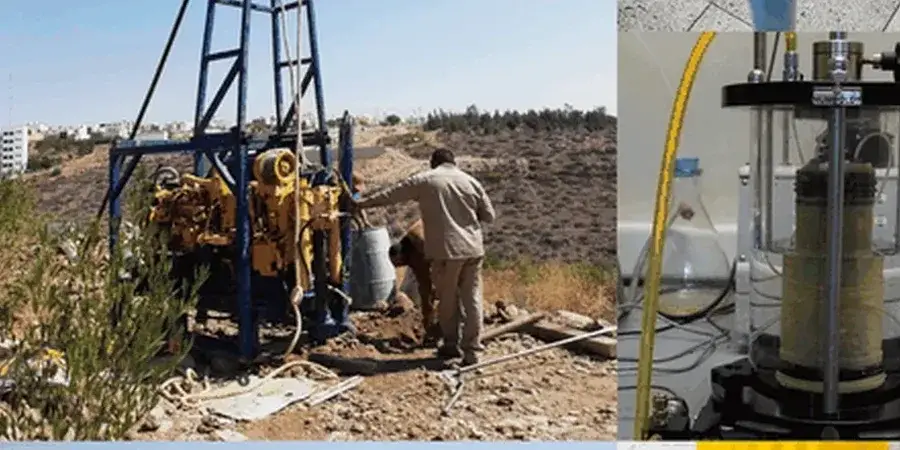
A common mistake local contractors make in Birkenhead is assuming the glacial till that dominates the Wirral peninsula is uniform across every plot. In reality, the superficial deposits vary from stiff boulder clay to loose sand lenses, especially near the Mersey shoreline. Without a proper soil mechanics study, foundation designs risk differential settlement and unexpected excavation costs. We combine rotary boreholes with standard penetration tests to map these layers accurately. Before specifying shallow footings, we recommend integrating the study with a muros pantalla analysis for deep basement excavations common in the town centre.
Glacial till variability across Birkenhead means borehole spacing every 25 metres is the minimum for reliable foundation design under Eurocode 7.
Process overview
Birkenhead sits on a mix of Triassic Sherwood Sandstone bedrock overlain by Quaternary glacial deposits. The water table fluctuates between 2 and 5 metres below ground level, influenced by tidal cycles from the River Mersey. A soil mechanics study in Birkenhead must therefore assess both bearing capacity and groundwater effects. We follow BS 5930:2015 for site investigation and sample recovery. Our laboratory programme includes:
Moisture content and Atterberg limits to classify soil plasticity
Triaxial shear strength (UU and CU) for undrained and effective stress parameters
Consolidation testing to predict long-term settlement under load
For projects on reclaimed docklands, we cross-reference results with a ensayo CPT to obtain continuous strength profiles without disturbing the soil structure.
Technical reference image — Birkenhead
Local context
Eurocode 7 (EN 1997-1:2004) requires that all limit states be verified using characteristic values derived from a soil mechanics study. In Birkenhead, the presence of soft alluvial deposits along the waterfront and historical mining beneath parts of the town introduces additional collapse risk. We perform liquefaction screening using the NCEER method (Youd & Idriss 2001) for sites within 200 metres of the Mersey. Overlooking these requirements can lead to excessive settlement or even structural failure during seismic events, however low the probability.
Desk study, walkover survey, rotary boreholes with SPT, installation of standpipes for groundwater monitoring, and laboratory testing including triaxial, consolidation, and chemical classification. Delivered with a factual report and interpretative design parameters.
02
Targeted Soil Mechanics Study for Extensions & Small Developments
Lightweight investigation using hand augers or window sampling to 6 m depth. Atterberg limits and moisture content only. Suitable for single-storey extensions where adjacent structures offer known performance data. Issued with a concise summary report.
Relevant standards
BS 5930:2015 – Code of practice for ground investigations, BS EN 1997-1:2004 (Eurocode 7) – Geotechnical design, BS EN ISO 22476-3 – Standard test method for SPT, BS 1377-2 – Standard test methods for liquid limit, plastic limit, and plasticity index
Common questions
How many boreholes are needed for a soil mechanics study in Birkenhead?
For a standard residential plot (up to 500 m²), we recommend a minimum of two boreholes to 10 m depth. Larger developments or sites with variable fill require one borehole per 200 m² plus an additional hole in each distinct geological unit. This follows the spacing guidelines in BS 5930.
What is the typical cost range for a soil mechanics study in Birkenhead?
A standard investigation for a detached house (two boreholes to 10 m, basic lab tests, factual report) falls between £2.600 and £3.880. Costs rise with deeper holes, additional sampling, or if specialised testing like triaxial shear or consolidation is required. We offer fixed-price quotes after a site visit.
How long does the whole process take from site visit to final report?
Mobilisation occurs within 5 working days of order confirmation. Drilling and sampling take 1–2 days on site. Laboratory testing runs for 2–3 weeks depending on the test schedule. The final interpretative report is delivered 4 weeks after fieldwork completion.
Do I need a soil mechanics study if I am only building a small extension in Birkenhead?
Yes, unless the existing building has a proven foundation record and the extension is within 3 m of the original structure. Glacial till variability can cause differential movement between old and new foundations. A targeted study using window sampling to 6 m depth is sufficient for most single-storey extensions and avoids unnecessary over-design.