← Home · Laboratory

Oedometer Consolidation Test in Birkenhead – Laboratory Soil Behaviour Analysis

Together, we solve the challenges of tomorrow.

READ MORE →

Birkenhead sits on a thick sequence of glacial till and post-glacial alluvial clays, often with high moisture content and low preconsolidation pressure. In our knowledge, the most common issue we see here is underestimating long-term settlement under embankments or shallow foundations on the Wirral foreshore. Before any load application, the oedometer consolidation test tells you exactly how much the ground will compress over time. Pairing this with a set of calicatas exploratorias to recover undisturbed block samples gives the lab a representative slice of the real profile. Without that oedometer curve, you are guessing at creep and primary consolidation rates.
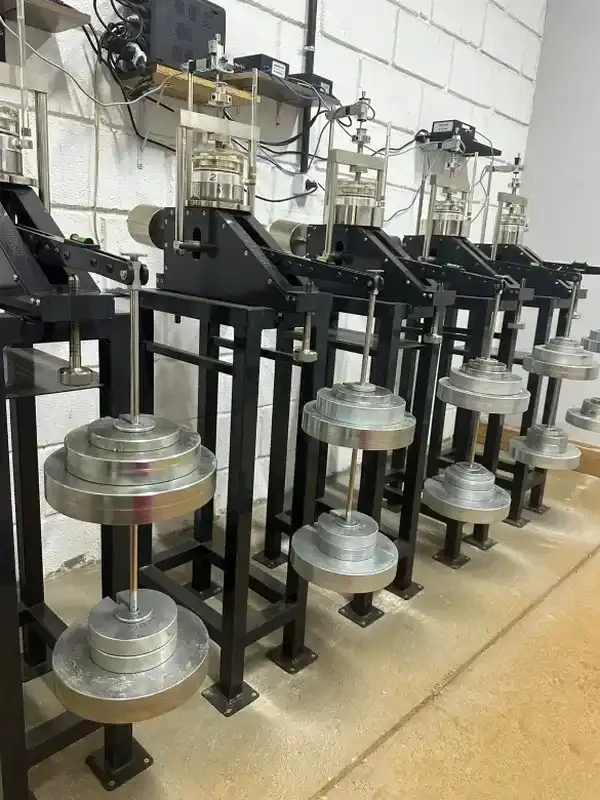
Illustrative image of Oedometer consolidation test in Birkenhead
For Birkenhead's laminated clays, a standard oedometer test reveals Cv values that can drop below 1 m²/year in the upper alluvium.

Process overview

The test follows BS 1377-5:1990, incrementally loading a confined specimen to measure coefficient of consolidation (Cv), compression index (Cc), and swelling index (Cs). For Birkenhead's laminated clays, we run a minimum of six load increments up to 1600 kPa. The procedure also requires careful saturation control, something the team here handles with back-pressure rigs calibrated weekly. When the natural water content exceeds 40%, as it often does in the tidal zone of the Mersey basin, we add an ensayo de clasificacion de suelos to confirm plasticity and organic content. The table below summarises typical parameters we extract from each test sequence.
Technical reference image — Birkenhead

Local context

Birkenhead's ground conditions include soft estuarine clays that can settle more than 100 mm under modest loads if the preconsolidation margin is exceeded. The main risk is differential settlement between areas underlain by till and those on soft alluvium. Without an oedometer consolidation test, you cannot quantify the time rate of that movement. In several recent projects along the docklands, ignoring the secondary compression phase led to serviceability failures in floor slabs and retaining walls. The oedometer data also feeds directly into the settlement analysis for embankments near the Mersey tunnel approaches.

Need a geotechnical assessment?

Reply within 24h.

Email: contact@geotechnical-engineering.biz

Technical parameters


ParameterTypical value
Coefficient of consolidation (Cv)0.5 – 8 m²/year
Compression index (Cc)0.15 – 0.45
Swelling index (Cs)0.02 – 0.08
Preconsolidation pressure (σ'p)80 – 250 kPa
Void ratio (e₀)0.7 – 1.8
Hydraulic conductivity (k)1×10⁻¹⁰ – 1×10⁻⁸ m/s

Additional services

01

Standard Incremental Loading Oedometer (IL)

Multi-stage loading from 12.5 to 1600 kPa with pore pressure dissipation monitoring. Suitable for general foundation design and embankment settlement estimates on Wirral clays.

02

Constant Rate of Strain (CRS) Oedometer

Continuous loading at controlled strain rate for high-void-ratio soils. Faster than IL, it provides Cv and permeability curves in one run. Ideal for soft alluvium profiles.

03

Swelling Pressure and Collapse Potential Oedometer

Measures heave under inundation and collapse on wetting. Essential for sites near the tidal River Mersey where desiccated crusts can rehydrate and cause upward movement.

Relevant standards


BS 1377-5:1990 (Methods of test for soils – Compressibility, permeability and durability tests), Eurocode 7 (EN 1997-2:2007 – Ground investigation and testing), BS 1377-5 (Standard Test Method for One-Dimensional Consolidation Properties of Soils)

Common questions

How long does a standard oedometer consolidation test take for Birkenhead clay?

A full incremental loading run with six stages typically takes 10 to 14 days. Each load increment is held until primary consolidation is complete, and for high-plasticity clays this can extend to 24 hours per stage.

What is the typical cost range for an oedometer test in Birkenhead?

The price usually falls between £190 and £410 per test, depending on the number of load increments and whether constant-rate-of-strain or swelling pressure variants are required. Bulk discounts apply for multiple specimens from the same borehole.

Can the oedometer test predict long-term creep settlement in Birkenhead alluvium?

Yes. Secondary compression (creep) is quantified using the Cα coefficient derived from the log-time curve after primary consolidation. In Birkenhead's soft clays, Cα/Cc ratios between 0.03 and 0.06 are common, and the oedometer test provides the direct measurement needed for creep-sensitive structures.

Location and service area

We serve projects across Birkenhead.

Location and service area