Birkenhead grew rapidly during the 19th century as a shipbuilding and industrial hub on the Wirral Peninsula, with much of its waterfront reclaimed from the Mersey estuary. That legacy means the subsurface is a patchwork of glacial till, laminated clays, and variable made ground from old docks and factories. For any deep excavation — whether a basement for a new apartment block or a shaft for a utility tunnel — we integrate historical ground models with modern site investigation data. Before specifying support systems, we routinely run MASW Vs30 surveys to map stiffness contrasts across the site, a step that directly informs the excavation stability analysis under Eurocode 7.
In Birkenhead's glacial till, the undrained shear strength can vary by a factor of three within 2 m vertically. That variability demands a design that accounts for both peak and residual parameters.
Process overview
We design to Eurocode 7 (EN 1997-1:2004) together with BS 5930 for site investigation, a combination that is especially relevant in Birkenhead because of the widely varying groundwater conditions. The underlying Sherwood Sandstone aquifer can create artesian pressures in excavations deeper than 5 m, while the overlying glacial lodgement till behaves as a low-permeability cap that traps perched water. Our methodology includes:
Finite-element modelling (Plaxis 2D/3D) to simulate wall deflection and ground movement
Effective-stress analysis for temporary and permanent support
Empirical correlations between SPT N-values and undrained shear strength in the laminated clays
This layered approach ensures that the chosen retention system — secant pile wall, sheet pile, or diaphragm wall — matches the actual ground conditions encountered on site.
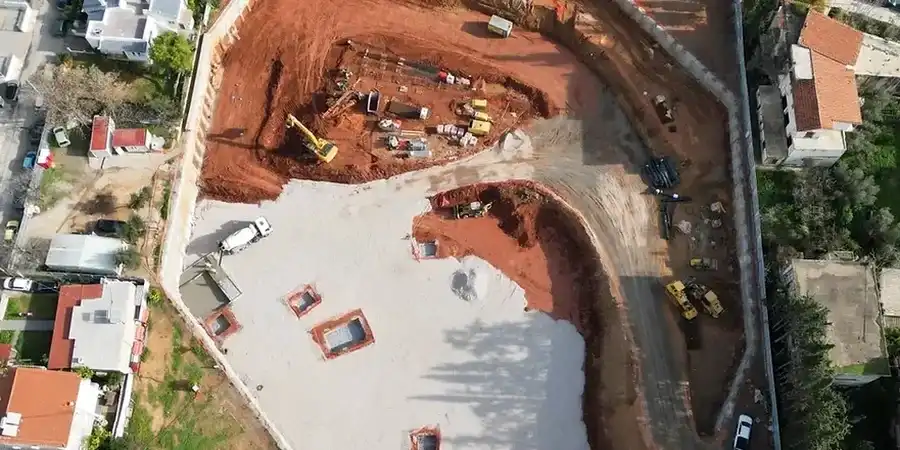
Technical reference image — Birkenhead
Local context
At 45 m above sea level, Birkenhead sits on a plateau cut by several steep-sided valleys that drain into the Mersey. These valleys host former in-filled quarries and uncontrolled fill from the Industrial Revolution. The most frequent geotechnical risk in deep excavations here is a sudden loss of lateral support due to a weak seam within the till or a high-permeability lens in the made ground. To mitigate that, we always include a trigger-action response plan in the design — pre-installed inclinometers and standpipes that alert the team the moment wall movement exceeds 5 mm or pore pressure rises beyond the design envelope. This is not theoretical; we have deployed it on four Birkenhead sites in the last year alone.
Design of propped and anchored retaining walls for basement construction, shaft sinking, and trench excavations. Includes wall embedment checks, groundwater control specification, and movement monitoring thresholds. Delivered as a standalone package or integrated with the permanent works design.
02
Permanent Basement Wall Design
Structural design of diaphragm walls and secant pile walls that act as both temporary support and final basement wall. Covers watertightness detailing, reinforcement sizing, and interface with the raft slab. All designs comply with Eurocode 2 and 7 simultaneously.
This service complements our laboratory testing work for a complete project analysis.
Relevant standards
Eurocode 7 (EN 1997-1:2004), BS 5930:2015 Code of practice for ground investigations, CIRIA C760 Guidance on embedded retaining walls
Common questions
What is the typical cost for a geotechnical design of a deep excavation in Birkenhead?
For a residential basement project (excavation 6–8 m deep), the design fee typically ranges between £1.900 and £6.820 depending on complexity, number of support levels, and whether groundwater modelling is required. We offer a fixed-price quotation after reviewing the site investigation report.
Do I need a full site investigation before the design can start?
Yes. The design relies on reliable ground parameters. We require at least SPT boreholes to 1.5× the excavation depth, together with groundwater monitoring data. If the existing investigation is sparse, we can recommend a supplementary phase targeting the specific strata in Birkenhead — typically the laminated clays and the made ground.
How do you handle the high groundwater table in Birkenhead?
We design a groundwater control system as part of the excavation support. For shallow excavations (≤5 m) sump pumping may suffice, but for deeper works we specify deep wells or ejector systems to maintain a dry working face. The design accounts for the hydrostatic pressure acting on the wall and includes a factor of safety against piping and bottom heave.
What wall deflection should I expect for a 9 m deep excavation in Birkenhead?
In the glacial till typical of Birkenhead, we design for a maximum lateral wall deflection of H/200, which for a 9 m excavation gives an allowable movement of 45 mm. Adjacent to sensitive structures we tighten that limit to H/300. The actual deflection depends on the wall stiffness, prop spacing, and ground stiffness, all of which we model explicitly.
How long does the design process take?
A typical design for a single basement with one level of props takes 3–4 weeks from receipt of the ground investigation report. Complex schemes with multiple props, groundwater control, or adjacent building protection can take 6–8 weeks. We issue the design in stages — wall geometry first, then reinforcement, then monitoring plan — so that construction can start before all details are finalised.