Birkenhead sits on a complex mix of glacial till, laminated clays, and made ground from its industrial port history. Many times we see unexpected voids or high permeability zones that standard foundation designs simply ignore. That is where grouting design becomes the only reliable solution. Before we develop a grouting program we always review the existing site data, and often recommend a consolidation test to understand compressibility, or an SPT profile to identify loose layers. For deep void treatments we also integrate MASW-Vs30 surveys to map stiffness contrasts across the site. The goal is to match the grout type, injection pressure, and spacing to the actual ground conditions, not to guess.
In Birkenhead’s variable ground, a single grouting campaign without prior Lugeon testing often leads to either wasted material or incomplete treatment.
Process overview
The glacial tills beneath Birkenhead typically exhibit undrained shear strengths between 50 and 150 kPa, but the interbedded sand lenses can cause sudden grout takes if not accounted for. We always run a water absorption test (Lugeon) before production grouting to define the permeability range. Our approach follows BS EN 12715:2001 for execution and Eurocode 7 for design verification. Key parameters we control:
Injection pressure limited to 1.5 times the overburden stress to avoid hydrofracture
W/C ratio starting at 2:1 and progressively thickened
Stop criteria based on refusal pressure and flow rate
All grout mixes are verified in our UKAS-accredited laboratory before mobilisation.
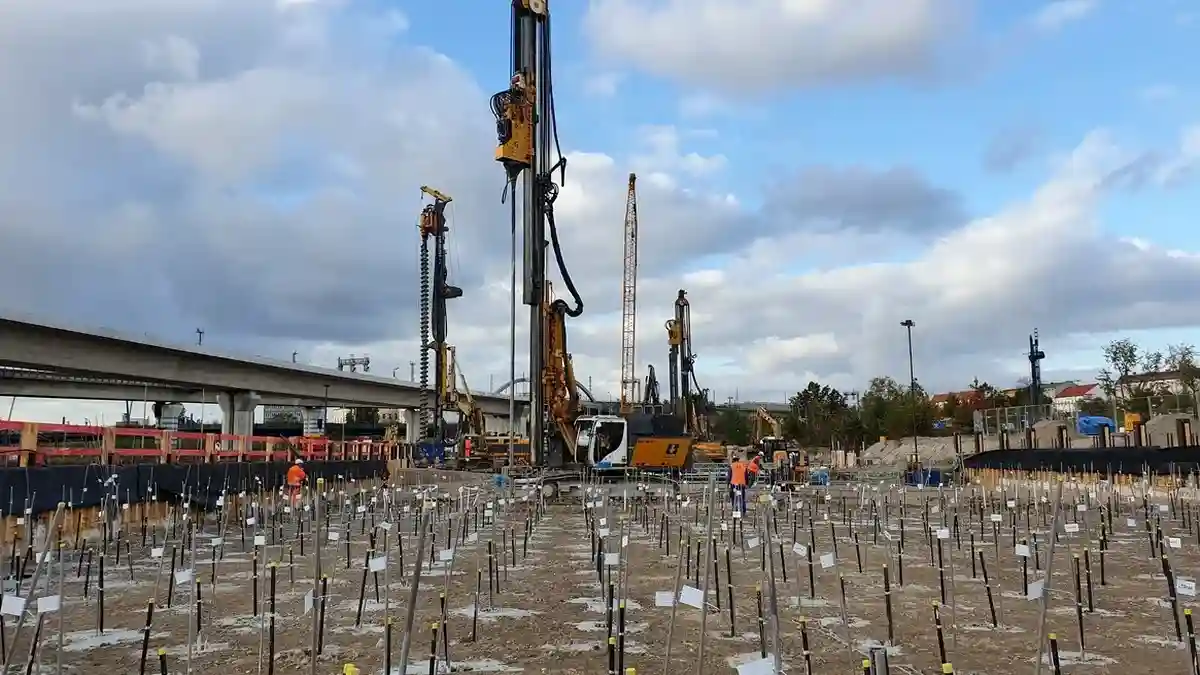
Technical reference image — Birkenhead
Local context
Birkenhead expanded rapidly during the 19th century dock construction, with extensive backfill over soft estuarine deposits. This made ground often contains buried timber, rubble, or old foundations that create preferential flow paths for grout. Without a proper grouting design, injected material can escape laterally or bypass the target zone entirely, leaving untreated voids that later cause settlement. We mitigate this by conducting pre-injection CCTV surveys and pressure testing every stage. The cost of rework after a failed grouting program far exceeds the initial investigation.
Low-pressure injection of cementitious or chemical grouts into soil pores. Ideal for sands and gravels where consolidation is needed without fracturing the matrix. We use microfine cements for silty sands typical of the Wirral peninsula.
02
Compensation Grouting
Controlled injection to lift or stabilise structures affected by adjacent excavations or tunnelling. In Birkenhead's urban areas, this technique is often required under existing buildings before new basement construction.
03
Fracture (Claquage) Grouting
Higher pressure injection that creates a network of grout lenses in stiff clays or weak rock. Used where permeation is not possible, such as in the laminated clays found beneath the Birkenhead docks area.
Relevant standards
BS EN 12715:2001 — Execution of special geotechnical works, Grouting, Eurocode 7 (EN 1997-1:2004) — Geotechnical design, BS 5930:2015 — Code of practice for ground investigations
Common questions
How much does grouting design cost in Birkenhead?
For a typical residential or light commercial site in Birkenhead, the design and testing phase ranges between £1.120 and £3.390 depending on the number of injection stages and the need for Lugeon testing. Production grouting is priced per cubic metre of injected material and can vary with volume.
What is the difference between permeation and fracture grouting?
Permeation grouting fills the existing pore spaces without disturbing the soil structure, suitable for granular soils. Fracture grouting creates new flow paths by hydrofracturing, which works in low-permeability clays. The choice depends on the soil type found at your Birkenhead site.
Do I need a grouting design if I am only building a small extension?
If your extension is on made ground or fills, yes. Shallow foundations over variable fill often settle unevenly. A targeted grouting program can treat loose zones before construction, saving far more than its cost in future repairs. We always recommend a trial hole first.
How long does a grouting design study take in Birkenhead?
A full design study including site visit, soil data review, and Lugeon testing typically takes 2 to 3 weeks. If we already have borehole logs from a previous investigation, the timeline can reduce to 7 working days.