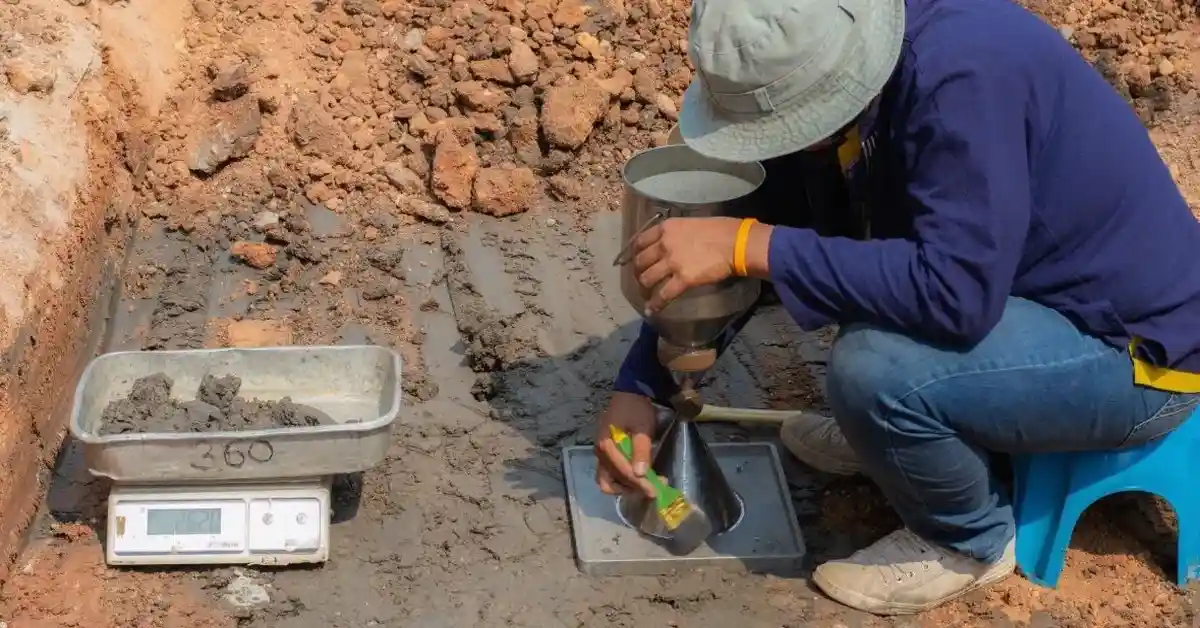
BS 5930 and Eurocode 7 (EN 1997-1:2004) set the framework for assessing collapsible soils, and in Birkenhead this is especially relevant given the area's glacial till overlying alluvial sands and estuarine silts. These deposits often exhibit a metastable structure that can collapse upon wetting, leading to differential settlement under load. Our team has evaluated several sites near the Mersey waterfront where historical fill and soft clays create conditions prone to sudden volume change. We typically start with a detailed site investigation that includes undisturbed sampling and double-ring infiltration tests, complemented by calicatas exploratorias to visually log collapse-prone layers and ensayo SPT to correlate blow counts with void ratio changes.
Collapse strains of 1.8-3.4% under 200 kPa in Birkenhead alluvium highlight why wetting-induced settlement must be accounted for in foundation design.
Process overview
Birkenhead's urban development in the 19th and 20th centuries saw extensive infill of tidal creeks and marshlands for docks and housing, leaving a legacy of heterogeneous fill that behaves unpredictably under saturation. The key characteristic we look for in collapsible soil evaluation is a high initial void ratio (typically e₀ > 0.8) combined with low dry density, often found in windblown sand or loose alluvium. In our experience, the collapse potential index (I_c) measured via oedometer testing at field moisture content and then flooded, gives a reliable indicator of risk. For a recent residential project in Rock Ferry, we recorded collapse strains of 1.8-3.4% under a 200 kPa surcharge, which triggered a redesign of the shallow foundations. We always cross-reference these results with granulometría to identify the fine content fraction that controls the capillary suction holding the structure together.
Technical reference image — Birkenhead
Local context
We use a standard oedometer frame with a 50 mm diameter ring and a 1.0 kN capacity proving ring, applying incremental loads up to 800 kPa. After reaching the final load step, we flood the specimen with distilled water and measure the additional compression over 24 hours. The collapse potential is defined as Δe/(1+e₀) where Δe is the change in void ratio upon wetting. In Birkenhead, we have observed that soils with an initial degree of saturation below 30% and a clay fraction less than 12% are most susceptible to sudden collapse, particularly after prolonged dry periods followed by heavy rainfall.
Thin-walled Shelby tube samples extracted from critical depths to preserve the natural moisture and structure, followed by collapse potential oedometer tests per BS 1377-5.
02
Field Infiltration & Moisture Monitoring
Double-ring infiltrometer tests and time-domain reflectometry (TDR) probes to measure wetting front advance and predict collapse-triggering moisture levels.
03
Foundation Risk Assessment & Mitigation Design
Calculation of allowable bearing pressure with collapse strain criteria, plus recommendations for pre-wetting, dynamic compaction, or deep foundation solutions.
Relevant standards
BS 5930:2015 – Code of practice for ground investigations, Eurocode 7 (EN 1997-1:2004) – Geotechnical design, BS 1377-5 – Standard test method for measurement of collapse potential of soils
Common questions
What is collapsible soil and why is it a problem in Birkenhead?
Collapsible soil is a metastable deposit that loses strength and compresses suddenly when saturated. In Birkenhead, glacial till and alluvial sands with low clay content and high void ratio are common, especially near the Mersey estuary. When these soils get wet from rainfall or broken drains, buildings can knowledge differential settlement.
How much does a collapsible soil evaluation cost in Birkenhead?
The cost typically ranges between £710 and £2,100 depending on the number of test locations, depth of sampling, and laboratory testing required. A single oedometer test with undisturbed sampling is around £450-£650, while a full site investigation with 3-5 test pits and collapse potential tests falls in the upper range.
What laboratory test measures collapse potential?
The oedometer collapse test (BS 1377-5) is the standard method. A soil specimen is loaded incrementally in a consolidation ring at its natural moisture content, then flooded at the final load step. The additional compression recorded is used to calculate the collapse potential index, typically expressed as a percentage of the original void ratio.
Can collapsible soil be improved without digging out the foundation?
Yes. Pre-wetting the soil to induce collapse before construction, dynamic compaction to densify loose layers, or deep soil mixing with lime/cement can stabilise the ground without full excavation. For shallow foundations, we sometimes recommend a reinforced raft slab that can tolerate small differential movements.
How long does a collapsible soil evaluation take?
A standard evaluation for a residential plot in Birkenhead takes 2 to 3 weeks from site work to final report. The field sampling and infiltration tests take 2-3 days, followed by 10-14 days for laboratory testing (including oedometer consolidation at multiple load steps) and another week for analysis and reporting.