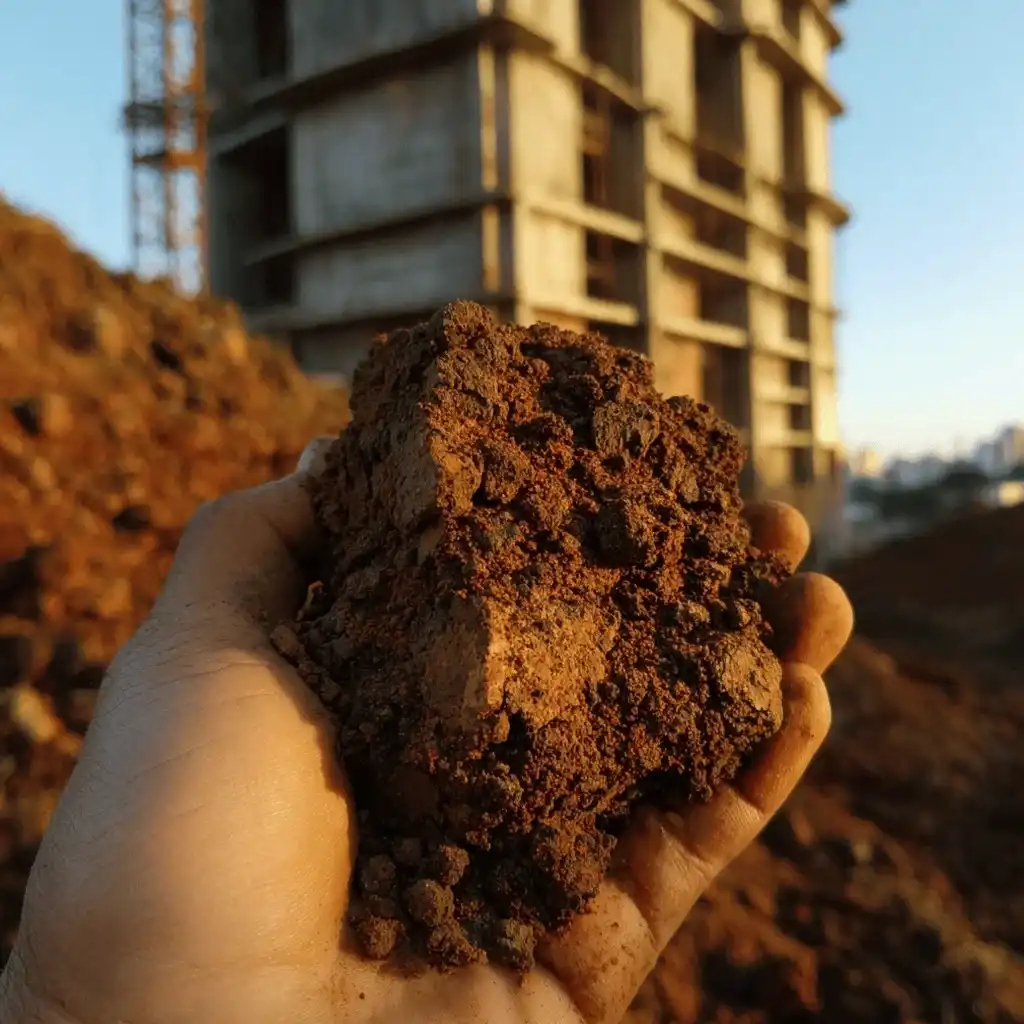
A common mistake among contractors in Birkenhead is assuming that all shallow ground behaves like a uniform fill or glacial till. The reality is that much of the town's subsurface consists of weathered Triassic sandstone and mudstone, forming a residual soil profile that varies dramatically over short distances. Ignoring the distinct engineering properties of these materials — such as their high void ratio, variable saturation, and tendency to lose strength upon remoulding — can lead to underestimated settlements or overestimated bearing capacities. A dedicated residual soil characterization program, following BS 5930:2015 guidelines, is the only reliable way to map these changes before detailed design. Complementing this work with a MASW-Vs30 survey helps correlate weathering depth with shear-wave velocity, while a parallel study of collapsible soils is advisable where the profile shows metastable fabric.
Weathered Triassic sandstone in Birkenhead can lose up to 40% of its intact stiffness when saturated — a fact often overlooked in routine desktop studies.
Process overview
Consider a typical residential development on Bidston Hill, where sandstone bedrock lies just a few metres below surface but is capped by a 2–3 m layer of sandy clay silt that has undergone centuries of oxidation and leaching. During that project, we observed that standard SPT N-values in the residual horizon ranged from 8 to 18 blows per 300 mm, yet moisture content fluctuated between 12% and 28% depending on the position on the slope. That variation directly affects compaction control and foundation bearing resistance. For this reason, a proper characterization campaign in Birkenhead should include:
Detailed logging of weathering grades (I to VI) per BS 5930
Atterberg limits to detect plasticity shifts in the clay fraction
Laboratory triaxial tests on undisturbed block samples
In-situ density and moisture content at 0.5 m depth intervals
We also cross-reference these data with an excavation support analysis when the cut depth exceeds 2.5 m, ensuring that the temporary works design accounts for the soil's true stiffness.
Technical reference image — Birkenhead
Local context
The climate in Birkenhead brings around 800 mm of annual rainfall, with wet winters that can raise the water table close to the surface in low-lying areas near the Mersey. When a residual soil profile becomes fully saturated, its apparent cohesion drops sharply, and the collapse potential — already present due to the metastable fabric inherited from the parent sandstone — can trigger sudden differential settlements under load. This is especially critical on sloping sites like those around Prenton and Rock Ferry, where lateral drainage paths are limited. A focused residual soil characterization programme identifies the zones most at risk and feeds directly into the foundation design, avoiding the need for costly remedial grouting later in the construction phase.
Systematic logging of core and trial-pit exposures from Grade I (fresh rock) to Grade VI (residual soil), with photographic record and description of fabric, colour, and mineral alteration. Essential for zoning the foundation-bearing stratum.
02
Index property suite
Determination of natural moisture content, Atterberg limits, particle size distribution, and specific gravity on samples obtained from each weathering horizon. These parameters control plasticity, compressibility, and compaction behaviour in Birkenhead's variable residual soils.
03
Triaxial strength testing (UU & CU)
Unconsolidated undrained and consolidated undrained triaxial tests on undisturbed block or thin-walled tube samples. Provides undrained shear strength and effective stress parameters for slope stability and foundation design in the weathered zone.
04
Collapse potential evaluation
Double-oedometer and single-oedometer collapse tests per BS 1377-5 on undisturbed specimens. Quantifies the settlement risk when the metastable residual fabric becomes saturated under load, a key concern in Birkenhead's wet climate.
Relevant standards
BS 5930:2015 – Code of practice for ground investigations, BS EN 1997-2:2007 – Eurocode 7: Ground investigation and testing, BS 1377-5 – Standard test method for measurement of collapse potential of soils
Common questions
What is the difference between residual soil and transported soil in Birkenhead?
Residual soil forms in place from the chemical and physical weathering of the underlying Triassic sandstone or mudstone. It retains relict structures like bedding planes and joints, but has lost much of the original rock strength. Transported soil, such as the glacial till found in parts of Birkenhead, was deposited by ice or water and has a completely different particle arrangement — typically denser and less prone to collapse upon wetting.
How deep should a residual soil characterization borehole go in Birkenhead?
The borehole or trial pit should extend at least 1.5 m into the unweathered bedrock, or to a depth where SPT N-values consistently exceed 40. In most of Birkenhead the full weathering profile is 3–5 m thick, so a depth of 6–7 m is usually sufficient to define the transition from Grade VI residual soil to Grade I rock.
Can residual soil in Birkenhead be used as engineered fill?
It depends on the degree of weathering and the moisture content at placement. Grade V and VI materials often contain a high proportion of fines and can be difficult to compact to the required density if the moisture content exceeds 20%. A full compaction control test (BS 1377:1990, Part 4) is necessary, and the material may require drying or blending with granular borrow before it meets specification for structural fill.
What is the typical cost of a residual soil characterization study in Birkenhead?
For a standard residential or small commercial site, the cost ranges between £750 and £2,410 depending on the number of boreholes, the depth of profiling, and the laboratory suite required. This typically includes weathering grade logging, index properties, and a collapse potential test on two undisturbed samples. Larger or more complex sites with multiple horizons may fall at the upper end of the range.
How does residual soil affect foundation design in Birkenhead compared to other UK cities?
In Birkenhead the residual soil is derived from relatively weak Triassic sandstone, whereas in London the residual profile comes from stronger chalk, and in Glasgow from weathered Carboniferous mudstone. The key difference is that Birkenhead's residual soils have a higher collapse potential and a more variable moisture regime due to the town's proximity to the Mersey estuary. Foundations must be designed with a higher factor of safety against differential settlement, and deep strip or piled foundations are often preferred over conventional shallow footings in the upper 2 m of the profile.