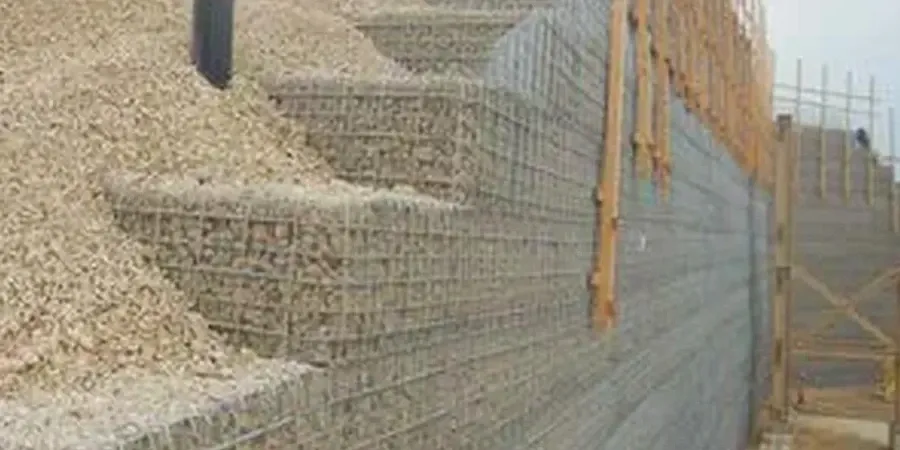
We recently worked on a site near the Birkenhead docks where the client needed a 6-meter-high retaining wall for a new logistics yard. The ground there is a mix of glacial till overlying Triassic sandstone, so we had to carefully select the reinforcement layout and facing system. Before finalizing the MSE wall design, we ran a series of field tests including the ensayo spt to measure blow counts in the till and combined that with a corte directo on undisturbed samples to get reliable shear strength parameters. The tidal influence from the Mersey meant drainage behind the wall was critical, so we also used permeabilidad campo to verify flow rates through the backfill. That combination gave us a solid basis for the reinforced soil block dimensions.
The tidal influence from the Mersey demanded careful drainage design behind the reinforced soil block to avoid build-up of pore pressure.
Process overview
Soils in the north end of Birkenhead near Bidston Hill tend to be stiffer with higher gravel content, while toward the waterfront you find softer laminated clays and occasional peat layers. That contrast forces us to adapt the MSE wall design significantly between neighbourhoods. For the stiffer tills we can use shorter reinforcement strips and wider spacing, but in the softer ground we need longer geogrid layers and often a stone column foundation to control differential settlement. The key parameters we check include:
Peak friction angle of the reinforced fill (usually 34-40 degrees for well-graded granular material)
Pullout resistance of the geogrid or steel strips embedded in the backfill
Bearing capacity of the foundation soil under the wall base
Global stability considering potential slip surfaces passing behind the reinforced zone
Each of these feeds into the design spreadsheet, and we verify the numbers against Eurocode 7 partial factors.
Technical reference image — Birkenhead
Local context
In Birkenhead, one of the most common issues we see is water seeping through the backfill after heavy rain, which can reduce the effective stress and trigger internal instability. The clay layers beneath the wall can also consolidate slowly, leading to post-construction settlement that cracks the facing panels. Another risk is inadequate compaction of the reinforced fill, which causes the geogrid to not engage properly with the soil. We always specify a compaction control protocol using densidad cono arena every 300 mm lift to ensure at least 95% of maximum dry density is achieved.
Trial pits, SPT boreholes, and laboratory testing (triaxial, direct shear, compaction) to characterize the foundation soils and select the reinforced fill material. We also install standpipes to monitor groundwater levels over several weeks.
02
MSE wall design and verification
Internal stability analysis (reinforcement pullout, rupture, connection), external stability (sliding, overturning, bearing), and global stability using limit equilibrium methods. Deliverables include calculation notes and construction drawings.
Relevant standards
Eurocode 7 (EN 1997-1:2004) – Geotechnical design, BS 8006-1:2010 – Code of practice for strengthened/reinforced soils, BS 5930:2015 – Code of practice for ground investigations
Common questions
What is the typical cost range for an MSE wall design in Birkenhead?
For a standard 4- to 6-meter-high wall, the geotechnical investigation plus design report typically falls between £970 and £3,960. The final figure depends on the number of boreholes required, the complexity of the ground conditions, and whether laboratory testing is needed for the reinforced fill.
What reinforcement materials work best with Birkenhead's glacial till?
We commonly use high-density polyethylene (HDPE) uniaxial geogrids with an ultimate tensile strength of 80-120 kN/m for walls up to 8 meters. In the stiffer tills, steel strip reinforcements with a zinc coating also perform well, provided the backfill pH is between 5 and 10 to avoid corrosion.
How long does the MSE wall design process take from start to finish?
The ground investigation phase (drilling, sampling, laboratory testing) usually takes 3 to 4 weeks. The design calculations and drawing production require another 2 to 3 weeks, assuming straightforward conditions. Complex sites with soft clays or high groundwater may add 1 to 2 weeks.
Do I need a separate drainage system behind a mechanically stabilized earth wall?
Yes, almost always. Without a drainage layer (typically 300 mm of clean gravel wrapped in geotextile), water can accumulate behind the reinforced zone and cause a rapid loss of stability. In Birkenhead, where the water table is shallow near the Mersey, we also install perforated pipes at the base to evacuate seepage.