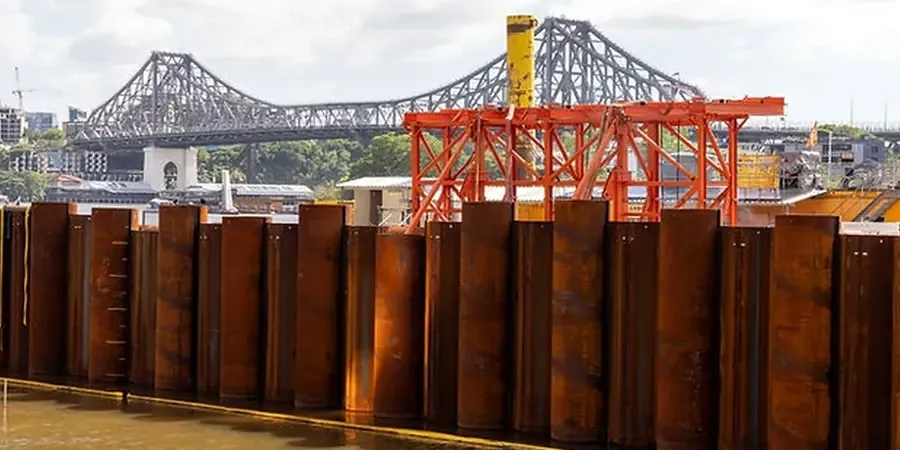
A recent project along the Mersey waterfront in Birkenhead required a 9 m deep excavation less than 12 m from the dock edge. The client needed a retaining system that could handle high hydrostatic pressures and dense glacial till interbedded with soft alluvial clays. Our team designed a cantilevered sheet pile wall using UK-calibrated parameters from adjacent boreholes. Before finalising the embedment depth, we cross-referenced the soil stiffness values with a plate load test at the same elevation and checked the pore pressure regime via in-situ permeability testing. That combination let us reduce the section modulus by 8 % without compromising safety.
A 9 m cantilever sheet pile wall was designed for a Mersey-side excavation, reducing section modulus by 8 % through in-situ permeability and plate load cross-checks.
Process overview
Sheet pile wall design in Birkenhead follows Eurocode 7 (BS EN 1997‑1:2004) and the UK National Annex, with specific attention to the high groundwater table typical of the Wirral peninsula. The design process includes:
Determining effective stress parameters from triaxial tests on undisturbed samples.
Modelling the wall as a beam on elastic foundation using subgrade reaction coefficients derived from pressumeter data.
Checking against rotational failure, structural yield, and hydraulic heave at the toe.
For walls in the dock area, we also account for tidal variations that can shift the water head by 3 m within six hours. The wall embedment depth is designed to prevent piping in the laminated silts that underlie much of central Birkenhead.
Technical reference image — Birkenhead
Local context
In Birkenhead, many engineers underestimate the effect of the tidal Mersey on sheet pile wall stability. We have seen designs that ignore the rapid drawdown condition: when the tide drops faster than the groundwater inside the excavation can drain, unbalanced pressures can push the wall forward. Another local risk is the presence of buried sandstone boulders within the glacial till — these can deflect piles, cause interlock damage, and lead to localised leakage. Our field team always specifies a pre-augering rig for the first 2 m to break up obstructions before the pile is driven, reducing the chance of misalignment.
Full structural and geotechnical design for single or multi-tied sheet pile walls. We calculate bending moments, embedment depths, and anchor forces using limit equilibrium and finite-element methods calibrated to local soil data.
02
Temporary Works Design
Rapid design for excavation support during construction. We offer section schedules, waling layouts, and propping arrangements that meet CDM 2015 requirements and can be adapted to site constraints within 48 hours.
03
Durability & Corrosion Assessment
Assessment of aggressive ground conditions (sulfates, chlorides) common in the Birkenhead dock area. We specify protective coatings, sacrificial thicknesses, or alternative pile materials to achieve a 50‑year design life.
Relevant standards
BS EN 1997‑1:2004 (Eurocode 7 – Geotechnical design), BS EN 1997‑1:2004 UK National Annex, BS 5930:2015 (Code of practice for ground investigations), CIRIA C760 (Guidance on embedded retaining walls)
Common questions
What is the typical cost range for sheet pile wall design in Birkenhead?
The design fee for a standard cantilever or anchored sheet pile wall in Birkenhead ranges from £1,190 to £4,730, depending on wall height, ground conditions, and the number of design iterations required. This includes a site visit, soil parameter review, and a full calculation report with drawings.
How does the high groundwater table in Birkenhead affect sheet pile wall design?
The water table in central Birkenhead is typically 1–2.5 m below ground, with tidal fluctuations of up to 3 m. The design must account for seepage forces, potential piping in laminated silts, and rapid drawdown conditions. We always include a hydraulic gradient check and specify adequate drainage behind the wall.
Can sheet pile walls be used in the glacial till found across the Wirral?
Yes, but the presence of cobbles and sandstone boulders in the till requires careful pile selection. We recommend high-strength AZ or PU sections with hardened driving shoes, and we often specify pre-augering through the upper 2 m to reduce the risk of pile damage or deflection. A trial pile is strongly advised.
What is the difference between a cantilever and an anchored sheet pile wall?
A cantilever wall relies solely on embedment depth for stability and is suitable for retained heights up to about 4 m in good ground. An anchored wall uses one or more rows of ground anchors or tiebacks to resist overturning, allowing taller walls — up to 12 m or more — with a shorter embedment. Anchored walls are common in Birkenhead dock projects where space behind the wall is limited.