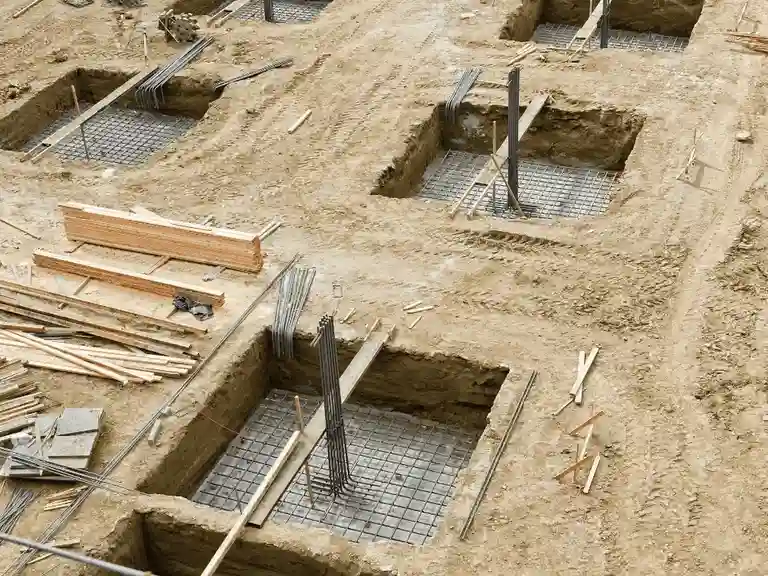
The contrast between the sandstone bedrock under Oxton and the deep glacial till of Woodchurch tells you everything about Birkenhead's geology. One side gives you competent bearing strata; the other demands careful seismic foundation design to avoid differential settlement under cyclic loading. Before we even touch a design calculation, we run a MASW survey to map Vs30 profiles across the site, then correlate those with borehole data. That combination is non-negotiable for any project near the Mersey or along the Wirral line.
In Birkenhead, the real seismic risk is not the earthquake itself — it is the liquefaction of the underlying sand lenses.
Process overview
A six-storey residential block in Birkenhead's town centre taught us why standard bearing capacity is never enough here. The ground looks uniform at surface level, but the glacial till contains lenses of sand and silt that behave differently during an earthquake. We break the seismic foundation design process into clear steps:
Site classification per ASCE 7 / NEHRP using shear wave velocity from surface wave surveys.
Liquefaction susceptibility screening following the NCEER (Youd-Idriss 2001) method.
Ground response analysis to compute acceleration amplification in the top 30 m.
Foundation sizing under combined static and seismic loads per Eurocode 7.
Each step relies on real lab data, not generic tables. We also cross-check against compression simple tests on undisturbed samples to validate strength parameters.
Technical reference image — Birkenhead
Local context
Eurocode 7 Part 1 (EN 1997-1:2004) and the UK National Annex set the framework, but Birkenhead's specific geology makes two risks critical. First, the water table sits less than 3 m below ground in many areas near the river, creating conditions for liquefaction in loose sandy layers. Second, the glacial till has variable stiffness — a stiff clay lens can sit right next to a soft silt pocket, causing differential displacement during shaking. We always flag these early so the structural engineer can decide between deep foundations or Improvement.
We measure Vs30 profiles using MASW and combine them with borehole logs to compute ground amplification factors. The result is a site-specific acceleration spectrum that feeds directly into your structural model.
02
Liquefaction Hazard Assessment
Using SPT blow counts, fines content, and Atterberg limits from on-site samples, we run the Youd-Idriss method to map liquefaction probability across the plot. We deliver contour maps of factor of safety versus depth.
Relevant standards
Eurocode 7 — EN 1997-1:2004 (UK National Annex), ASCE 7-22 — Site classification and seismic loads, NCEER 1996/2001 — SPT-based liquefaction evaluation, BS 5930:2015 — Code of practice for ground investigations
Common questions
How much does seismic foundation design cost in Birkenhead?
A full seismic assessment including site response analysis and liquefaction screening typically falls between £1.000 and £3.510. The exact figure depends on the number of boreholes, the depth of investigation, and whether you need a full ground response analysis or a simplified screening.
Do I need seismic design for a small residential extension in Birkenhead?
It depends on the site class. If your extension sits on shallow bedrock (Class A or B), the seismic demand is low. But many plots in Birkenhead fall into Class D due to thick glacial till, which amplifies ground motion. A quick Vs30 survey will tell you if you need to consider seismic loads at all.
What is the difference between liquefaction screening and full ground response analysis?
Liquefaction screening checks if the soil has the potential to lose strength during shaking — it uses SPT data and fines content. Ground response analysis goes deeper: it models how seismic waves travel through the soil column and computes the actual acceleration at foundation level. We usually recommend the full analysis for buildings taller than three storeys or with irregular mass distribution.
How long does a seismic foundation design study take?
From site visit to final report, expect 2 to 3 weeks for a standard residential project. If we need to run a full ground response analysis with numerical modelling, add another week. We coordinate with your structural engineer to avoid delays on the critical path.