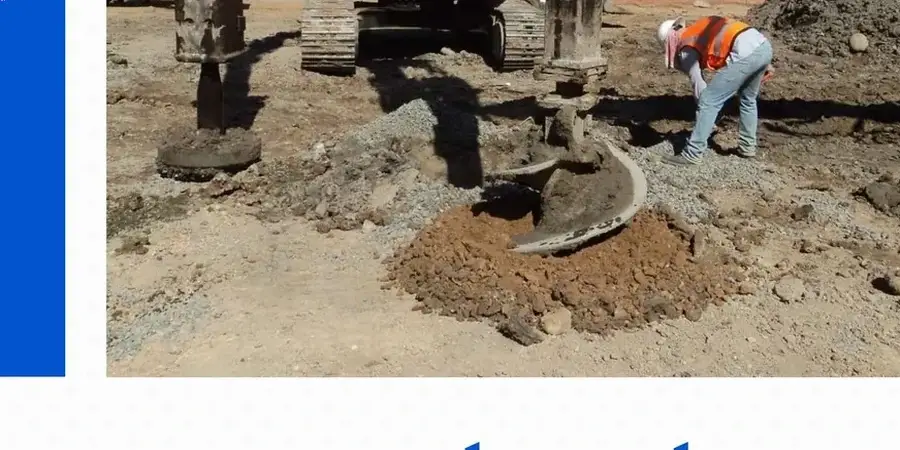
Birkenhead sits on a mix of glacial till and soft estuarine clays from the River Mersey's floodplain, a geology that often shows low bearing capacity and high compressibility. For projects requiring load support on these weak strata, stone column design provides a proven Improvement method. By displacing and compacting granular material into the soft layer, we create stiff columns that reduce total and differential settlement while increasing the soil's shear strength. Before specifying the layout, we run a site investigation including CPT and SPT soundings to map the soil profile. In Birkenhead, where the water table sits close to the surface, the drainage function of stone columns also accelerates consolidation — a key advantage for road embankments and industrial slabs. Our team follows Eurocode 7 (EN 1997-1:2004) to size the column diameter, spacing and depth based on the actual soil parameters from the trial pit or borehole data.
Stone columns reduce total settlement by 40–60% in soft Birkenhead clays when designed with the correct area replacement ratio and drainage path.
Process overview
Birkenhead's urban expansion since the 19th century has pushed construction onto reclaimed docklands and former marshland, where the ground is notoriously variable. Stone column design in this context demands a thorough understanding of the local stratigraphy: soft silty clays overlying dense glacial sands. We typically combine stone columns with a granular drainage blanket to handle the perched water that often appears after heavy rain, and we verify the column stiffness through plate load tests on the first trial columns. The method works well for bearing pressures up to 200–300 kPa, which suits most residential and light commercial developments in the area.
Column diameter: 0.6–1.2 m depending on stone grading and installation method (vibro-replacement or vibro-displacement)
Spacing: 1.5–3.0 m in a triangular or square grid based on the required area replacement ratio
Depth: typically 5–12 m until reaching the dense glacial sand or rockhead
For deeper soft layers or higher loads, we cross-check the design against a consolidation settlement analysis to ensure long-term performance stays within acceptable limits.
Technical reference image — Birkenhead
Local context
A common mistake we see on Birkenhead sites is assuming stone columns alone can handle any waterlogged condition. Contractors sometimes omit the horizontal drainage layer between column tops, so pore water cannot escape during loading — this leads to excess pore pressure and delayed settlement. Another error is designing the columns based on a single borehole in a variable clay layer. Without a proper grid of CPT or SPT tests, the area replacement ratio can be wrong in zones where the soft clay is thicker than expected. In Birkenhead, where old tidal channels cut through the till, missing a deep pocket of soft material can cause the entire improved zone to settle unevenly. We always insist on at least one trial column with a full load test before mass production.
Full design package including column layout, stone grading specification, settlement calculations and drainage check. We issue a design report with construction drawings and QA/QC criteria for the contractor.
02
Trial column and load testing supervision
On-site supervision of trial column installation, plate load tests (static or cyclic) and verification of column diameter and continuity. We compare results against the design assumptions and adjust the spacing if needed.
This service complements our laboratory testing work for a complete project analysis.
Relevant standards
Eurocode 7 — EN 1997-1:2004 (geotechnical design), BS 5930:2015 (site investigation code of practice), BRE Digest 471 (stone columns for Improvement)
Common questions
How deep do stone columns need to go in Birkenhead's soft clays?
Typically between 5 and 12 metres, depending on the thickness of the soft estuarine clay and the depth to the underlying dense glacial sand or rockhead. We determine the exact depth from CPT or borehole data during the site investigation.
Can stone columns handle the high water table in Birkenhead?
Yes, stone columns act as vertical drains that accelerate consolidation under load. The key is to connect them to a horizontal drainage blanket at the top; without that, the columns fill with water and lose their drainage function. We always include a drainage layer in our design.
What is the typical area replacement ratio for a residential development on reclaimed land?
For a bearing capacity of 150 kPa and allowable settlement of 25 mm, we usually work with an area replacement ratio between 0.15 and 0.25. That translates to columns of 0.8 m diameter spaced at about 2.0 m centre-to-centre in a triangular grid.
What tests do you run to verify stone column performance in Birkenhead?
We perform plate load tests on trial columns (up to 2.5 times the working load), column integrity testing using a lightweight deflectometer, and in some cases cone penetration tests between columns to check the improvement in soil stiffness. The results are compared against the design settlement predictions.
How much does stone column design and testing cost in Birkenhead?
The design and supervision package for a typical residential development (50–100 columns) ranges between £1.150 and £4.050, depending on the number of trial columns and load tests. This includes the design report, construction drawings and on-site verification.