Diaphragm wall design in Birkenhead demands rigorous adherence to Eurocode 7 (EN 1997-1:2004) and BS 5930. The local geology, dominated by glacial till and laminated clays overlying Bunter Sandstone, creates variable lateral earth pressures. We use the effective stress method with drained strength parameters for long-term stability. For shallow obstructions or variable strata, we first run calicatas exploratorias to map soil interfaces before panel layout. Our team has delivered schemes for basement excavations and cut-off walls in the Wirral peninsula for over a decade.
Glacial till in Birkenhead can exhibit high stiffness but also contains sand lenses that control seepage around panels.
Process overview
We deploy a hydrofraise or clamshell grab depending on panel depth and ground stiffness. In Birkenhead, the stiff to very stiff till requires high cutting torque. We work with bentonite or polymer slurries to maintain trench stability. Parameters we evaluate include:
Undrained shear strength (cu) by triaxial tests on U100 samples
Horizontal subgrade reaction coefficient (kh) from pressuremeter tests
Interface friction angle between wall and soil
Permeability of the till via permeabilidad de campo tests
All equipment is UKCA marked and our laboratory holds UKAS accreditation to ISO 17025. We calibrate pressure transducers before each campaign.
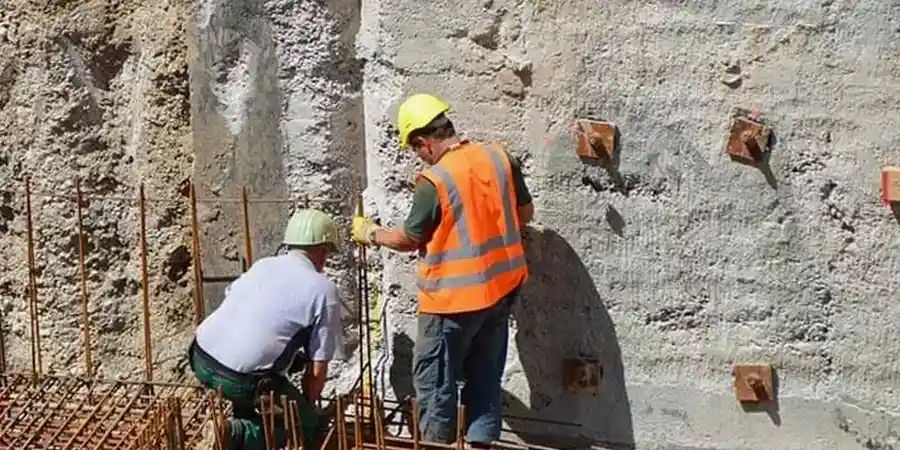
Technical reference image — Birkenhead
Local context
The coastal climate of Birkenhead brings persistent rainfall and high groundwater levels. Perched water tables in the till cause rapid sloughing of sidewalls if slurry head is miscalculated. We design each diaphragm wall panel with a minimum 1.5 m slurry head above the highest recorded piezometric level. The risk of hydrostatic uplift during concrete placement is modelled with a 3D finite element seepage analysis. We also assess the potential for bottom-heave in deep basements cut into the underlying sandstone. Proper diaphragm wall design in Birkenhead hinges on these local hydraulic conditions.
Reinforced concrete panel layout and connection detailing per BS EN 1992-1-1. We calculate bending moments and shear forces from soil and water pressures.
02
Stability and embedment analysis
Limit equilibrium method for rotational stability. We determine toe embedment depth in till or sandstone to prevent basal heave.
03
Seepage and cut-off design
Flow net analysis to estimate leakage rates through joints and base. We specify waterstops and grout curtains where required.
04
Construction stage checks
Slurry trench stability during excavation. We review concrete placement rates and tremie method to avoid cold joints.
Relevant standards
Eurocode 7 (EN 1997-1:2004), BS 5930:2015 – Code of practice for ground investigations, CIRIA C580 – Embedded retaining walls, BS EN 1538:2010 – Execution of diaphragm walls
Common questions
What is the typical cost range for diaphragm wall design in Birkenhead?
For a complete geotechnical design package including parameter interpretation, stability checks, and reinforcement detailing, the range is between £1.400 and £5.030. The final cost depends on panel count, ground investigation depth, and complexity of the hydrogeological model.
How does the glacial till in Birkenhead affect wall stiffness assumptions?
The till is overconsolidated with a high small-strain stiffness (G0). We use the Hardening Soil model in PLAXIS to capture non-linear behaviour. Ignoring the stiff response leads to uneconomical reinforcement. We calibrate the model with triaxial and pressuremeter data.
Do you need a full ground investigation before diaphragm wall design?
Yes. We require at least two boreholes per panel zone to 1.5 times the wall depth. We need SPT N-values, undisturbed samples for triaxial testing, and permeability data. Without these, we cannot certify the design under Eurocode 7.